Cherry Beach sits at the foot of Cherry Street, in the Port Lands. You get there past warehouses and a decommissioned power plant, and then the road runs out at the lake. It is the least polished beach in the city, and for more than twenty years it has been Toronto's summer dance floor. Here is how that happened, with the outside facts sourced and our own view marked as ours.
A beach made of fill
None of this ground is original shoreline. In 1858 a storm cut through the peninsula that became the Toronto Islands, and a small community grew on a sandbar called Fisherman's Island, roughly between today's Cherry Street and Woodbine Avenue. Behind it was Ashbridge's Bay, a marsh that the growing city turned into a sewer.
The Toronto Harbour Commission's 1912 plan filled the marsh to make an industrial district — the Port Lands — and set aside a strip for recreation: cottages, a park, and a beach beside an artificial lagoon. Fisherman's Island disappeared under the fill. In the 1930s the city opened Clarke Beach Park, named after alderman Harry Clarke. Everybody called it Cherry Beach anyway, and in 2003 the city made that the official name.
It was busy early. Heritage Toronto notes that in the 1950s the beach needed 14 lifeguards on hot days, and that in 1969 around 15,000 people came out to watch an air show. Industry never left: in 2012 an environmental assessment found lead and zinc in the soil above guidelines.
The history the name also carries
"Cherry Beach Express" was a 1984 song by the Toronto band Pukka Orchestra. The title refers to allegations that, from the 1940s to the 1990s, police took people — gay men and lesbians, Indigenous people, homeless people — to the secluded beach and beat them. It is part of the place, and we'd rather say so than dance over it.
How the beach started dancing
The Sunday parties most people mean by "Cherry Beach" belong to Promise, run by David Macleod and Irving Shaw. VICE dates their parties to 2001. On the beach they started without permission; after bylaw officers broke up a gathering in 2007, they got permission from the city the next summer, with help from councillor Paula Fletcher. (blogTO has dated the Sunday beach parties to 2000; accounts differ on the first year.)
The rules were unusual then and still are: the parties are free, there are no sponsors, and "there's really nothing for sale". No DJ plays twice in the same summer, so a season works as a survey of the city's DJs. The crowd is expected to look after itself and take its trash home.
Our view: that is still the best template for a party in public space in this city. Free, no brand on the booth, everyone responsible for the ground they dance on.
Our two afternoons
SYN/TO played the beach twice in summer 2026, under the name CHERRY, both daytime to sunset and free to get in:
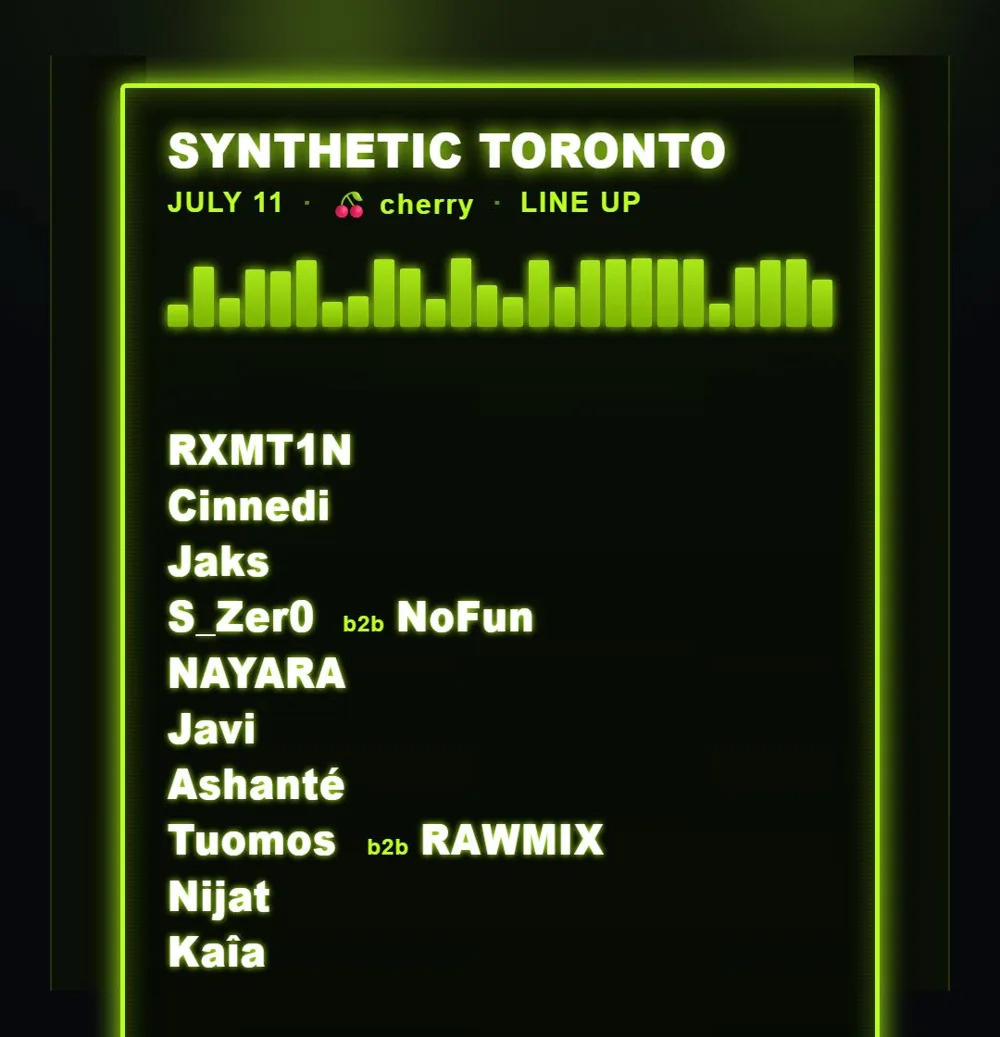
- SYN-003, 11 July 2026 — RXMT1N, Cinnedi, Jaks, S_Zer0 b2b NoFun, NAYARA, Javi, Ashanté, Tuomos b2b RAWMIX, Nijat, Kaîa.
- SYN-005, 25 July 2026 — Sebba b2b Halcyon, Julliette, Ayla, Hadis, Javi, Autul, Burnii, Nijat, Latenight b2b A-Nath, Piran b2b Javi.
What we learned, in our words: daylight changes techno. The music we'd play at 3 a.m. in a dark room sounds different at 5 p.m. with the lake behind the decks, and the long build towards sunset does the job the lights do indoors. The phones-away rule is harder outside and matters more.
If you go
Cherry Beach is a public park, not a venue. The lifeguard station, the off-leash dog area and the people who were there before the speakers arrived all have the same claim to it. Bring water, take everything home, keep the volume where the neighbours can live with it. The beach has outlasted a lot of parties; the reason it still hosts them is that most of them left it the way they found it.